


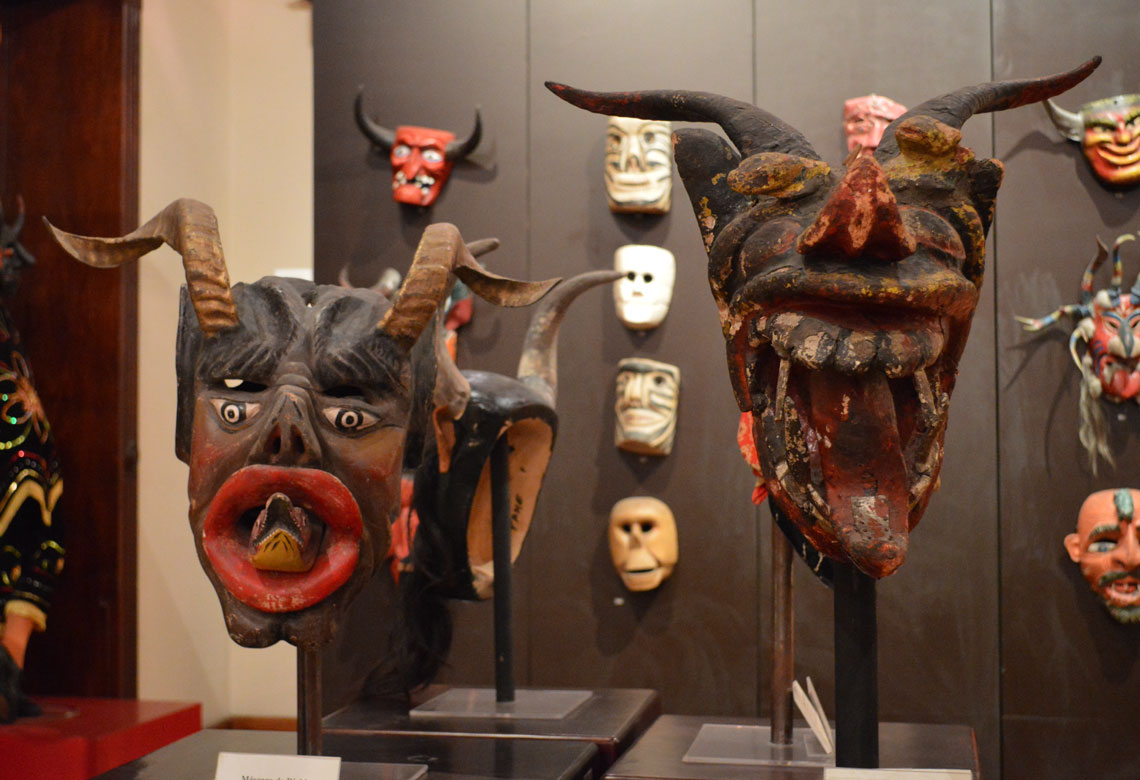
In the heart of San Luis Potosí’s historic centre, a neoclassical building from the late 1800s has taken on a renewed purpose. The recently inaugurated National Mask Museum, located in the restored Palacio Martí, now houses one of Mexico’s most comprehensive collections of traditional ceremonial masks—over 1,300 pieces drawn from 25 states. With its opening, the city strengthens its position as a cultural destination beyond its colonial façades, offering visitors a deeper engagement with Mexico’s intangible heritage.
Masks in Mexico are more than decorative artefacts; they are vessels of memory and identity. Their use spans centuries, rooted in pre-Hispanic rituals and later transformed through colonial-era syncretism. From the Yaqui deer dancers of Sonora to the Diablos of Guerrero and the Parachicos of Chiapas, each mask embodies a specific regional narrative. The museum’s curatorial approach reflects this diversity, presenting masks not merely as objects, but as expressions of living traditions shaped by local cosmologies, seasonal festivals, and shifting social contexts.
The institution’s mandate goes beyond display. It aims to preserve and contextualize mask-making as a dynamic craft, integrating rotating exhibitions and educational programming to highlight both historical continuity and contemporary innovation. In doing so, it acknowledges that these traditions are not frozen in time but evolve alongside the communities that sustain them. Such efforts resonate with broader national initiatives to valorize intangible cultural practices amid the homogenizing pressures of globalization.
Each mask embodies a regional narrative shaped by ritual, history, and ongoing adaptation.
San Luis Potosí’s designation as a UNESCO Creative City of Music since 2017 already signalled its cultural ambitions. The establishment of a national museum devoted to masks reinforces this trajectory, positioning the city as a regional hub for heritage-based tourism. Its central location and architectural charm make it an accessible point of entry for exploring Mexico’s ritual arts, while also encouraging dialogue between urban institutions and rural artisans whose work often remains underrepresented.


Yet institutionalizing folk traditions within formal museum settings is not without tensions. Removed from their ritual contexts, masks risk being perceived as static relics rather than functional elements of community life. While national recognition affirms their cultural value, it does not always translate into equitable support for the artisans who create them or the communities that animate them through performance. Accessibility remains uneven, and cultural tourism—if not carefully managed—can flatten complex practices into marketable symbols.
Still, the museum arrives at a moment when domestic interest in regional identity is resurgent. Post-pandemic travel patterns have favoured destinations that offer cultural depth and authenticity. In this climate, institutions that foreground local knowledge and craftsmanship have an opportunity to shape more sustainable and inclusive forms of tourism. By framing mask-making as both art and ritual, tradition and adaptation, the National Mask Museum invites reflection on how heritage can be preserved without being ossified.


